


Legal Drafting Services
Affidavit Drafting Service in Pakistan – Legal Drafting & Free Samples
PK-Legal & Associates provides professional affidavit drafting services in Pakistan for court proceedings, government departments, embassies, educational institutions, banks, businesses and other official purposes. We prepare affidavits according to the facts supplied by the client and the requirements of the authority where the document is intended to be submitted.
An affidavit is more than a formatted statement. Its wording should identify the deponent correctly, state relevant facts clearly, avoid unsupported conclusions, contain an appropriate verification, and be executed in the manner required for its intended use. A document may look like an affidavit but still be rejected if the wording, execution, attestation or supporting details don’t meet the relevant requirement.
A complete guide to affidavit drafting in Pakistan — what an affidavit actually is, the difference between drafting, swearing and notarization, the types we draft, execution guidance, and free sample formats you can adapt.
Section 139, CPC 1908
Section 8, Notaries Ordinance 1961
What Is an Affidavit?

An affidavit is a written statement of facts made by a person (the deponent) and sworn or affirmed before a person legally authorized to administer the oath or take the affidavit. Affidavits are commonly used to place facts formally on record before courts, public authorities, educational institutions, banks, embassies and private organizations.
The purpose of the affidavit determines its wording. A court affidavit may need to identify which statements are based on personal knowledge and which are based on information or record. An affidavit for a government department or embassy may instead need to address a specific factual declaration, identity issue, lost document, relationship, residence, financial support or no-objection requirement.
What Our Affidavit Drafting Service Includes
Purpose Assessment
We first identify where the affidavit will be submitted, what the authority requires and what facts actually need to be stated.
Custom Drafting
The affidavit is drafted around the client’s facts rather than copied from a generic internet template.
Legal Structure
We organize the deponent details, factual paragraphs, verification and execution section in an appropriate legal format.
Document Review
Where relevant, supporting records are reviewed so names, dates, document numbers and material facts are stated consistently.
Revision Before Execution
You can review factual details before the document is finalized for signature and swearing or attestation.
Execution Guidance
We explain the next step — whether the document is to be sworn before an Oath Commissioner, taken before a Notary Public, executed before a court or authorized officer, or handled according to a specific institution’s requirements.
Drafting, Swearing and Notarization Are Different Steps
These terms are often used as though they mean the same thing. They don’t.
Types of Affidavits We Draft in Pakistan
There is no single universal affidavit for every purpose. The correct document depends on the factual declaration required by the receiving authority. Common instructions include:
How Our Affidavit Drafting Process Works
Tell Us the Purpose
Share the purpose of the affidavit and the name of the court, department, embassy, bank, university, company or other authority where it will be submitted.
Share Your Details and Facts
Share your identification details and the facts that must be stated. Supporting documents should be provided where they affect names, dates, numbers or the substance of the declaration.
We Draft the Document
We identify the appropriate affidavit structure and draft the document around the facts and intended use.
You Review the Draft
You review the factual details and confirm any corrections before execution.
We Finalize and Explain Execution
We finalize the draft and explain the applicable signing, swearing/affirmation or attestation step.
Execution Is Arranged
Where original documents, courier, or an in-person oath is required, that step is handled separately according to the applicable requirement.
Information and Documents Normally Required
Affidavits for Courts and Litigation
Court affidavits should not be treated as ordinary general-purpose declarations. They may form part of the evidentiary or procedural record and must be prepared according to the applicable procedural law and court rules. The affidavit should normally identify the deponent, state relevant facts in a clear sequence, avoid unnecessary argument, distinguish personal knowledge from information where required, and contain a proper verification and attestation.
Under Section 139 of the Code of Civil Procedure, 1908, an oath on an affidavit under the Code may be administered by the persons specified in that provision. High Court rules and local court practice may further regulate how affidavits are sworn, identified and filed.
Affidavits for Government, Embassy, Education, Banking and Business Use
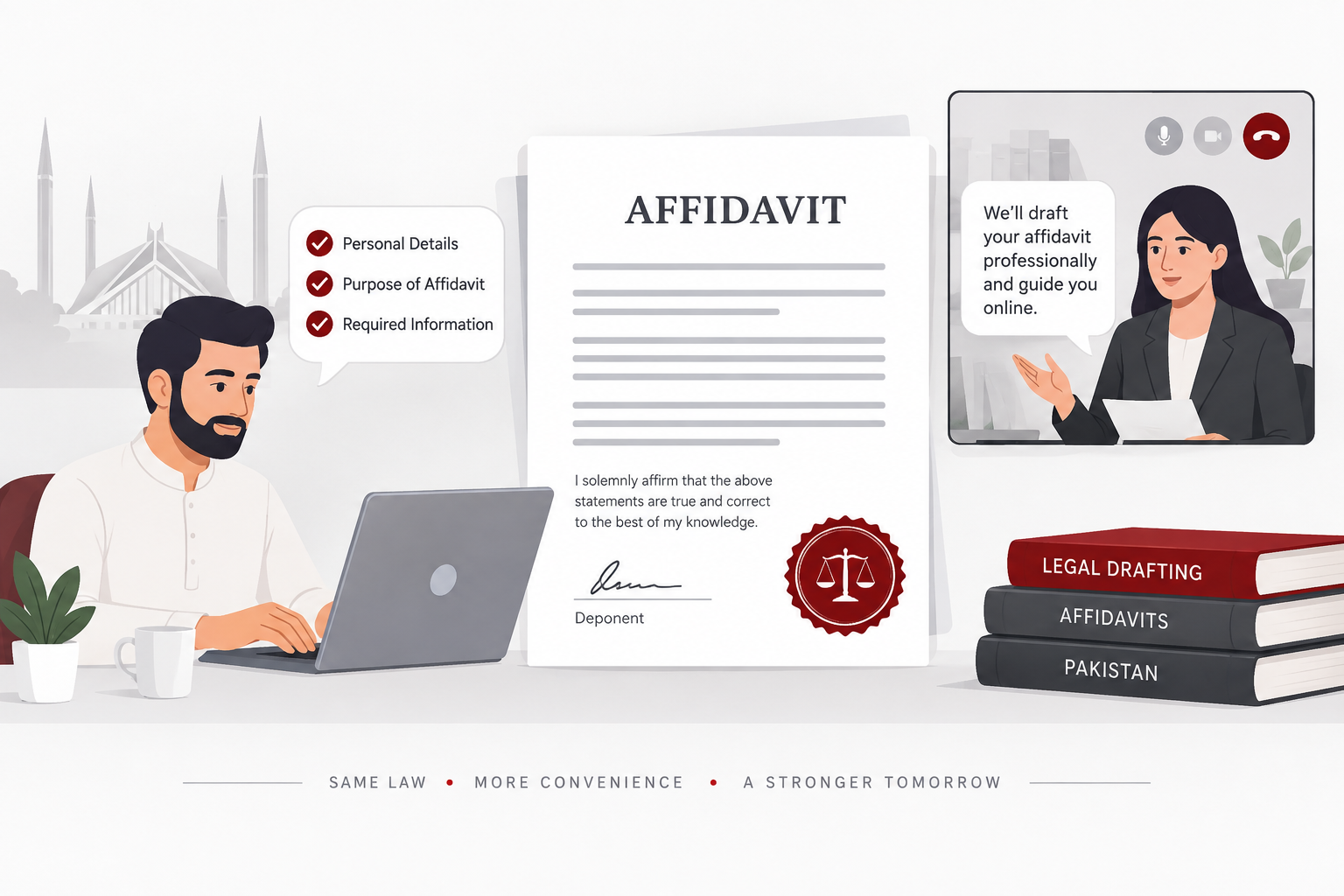
Many affidavits are non-litigation documents. Government departments, embassies, universities, banks, employers and private organizations may ask for a sworn declaration to confirm a particular fact. In these matters, the first question should be: what exactly does the receiving authority require the deponent to confirm?
A good affidavit should answer that requirement directly. Unnecessary legal language, copied clauses and irrelevant facts can make the document less clear. Where an authority has prescribed a form, stamp value, witness requirement, attestation method or supporting documents, those requirements should be followed rather than replaced by a generic format.
Affidavits for Overseas Pakistanis
PK-Legal can prepare affidavit drafts for Pakistanis living abroad where the declaration is intended for use in Pakistan or relates to Pakistani documentation. The drafting stage can normally be handled remotely by receiving the factual instructions and supporting documents electronically.
Execution is a separate issue. Depending on where the affidavit is signed and where it will be used, the client may need to execute it before a Pakistani diplomatic mission, a local notary or another competent authority, followed by any authentication, legalization or apostille step required for the destination and document type. The correct route should be confirmed for the specific receiving authority before the document is signed.
Need an Affidavit Drafted for a Specific Purpose?
Send us the requirement issued by the court, department, embassy, bank, university or other authority together with your identity details and the facts to be stated.
Legal Framework for Affidavits in Pakistan
Affidavit requirements in Pakistan arise from more than one source. The relevant law depends on whether the affidavit is judicial, notarial or required by a particular authority.
Oaths Act, 1873
Provides the general statutory framework relating to judicial oaths, affirmations and the authority of courts/persons to administer them in the circumstances covered by the Act.
CPC, 1908 — Section 139
Specifies who may administer the oath in the case of an affidavit under the Code.
Notaries Ordinance, 1961 — Section 8
Among the statutory functions of a notary is the power to administer an oath to, or take an affidavit from, a person.
High Court & Court Rules
May prescribe the format, identification, endorsement, verification, exhibits and filing requirements for affidavits used in judicial proceedings.
Free Affidavit Sample Formats for Pakistan
The following samples are intentionally short starter structures. They’re useful for understanding the format, but should be adapted to the actual facts and the requirements of the receiving authority before signature or swearing. For court matters or high-stakes official use, customized drafting is preferable.
Sample 1 — General Purpose Affidavit
For a straightforward factual declaration where no special institutional format has been prescribed.
I, [Full Name], son/daughter of [Father’s/Husband’s Name], holder of CNIC/NICOP No. [number], resident of [complete address], do hereby solemnly affirm and state on oath as follows:1. That I am the deponent named above and am fully conversant with the facts stated in this affidavit.
2. That [state the first material fact clearly, including any relevant dates].
3. That [state the second material fact, including relevant document numbers or references if applicable].
4. That [add a third fact if required, or remove this line if not needed].
5. That this affidavit is being sworn for submission before [name of authority/department] for the purpose of [state purpose clearly].
VERIFICATION: Verified on this [date] that the contents of the above affidavit are true and correct to the best of my knowledge and belief, and nothing has been concealed therefrom, subject to any court- or authority-specific wording required.
Dated: [DD/MM/YYYY]_________________________
DEPONENT
Sample 2 — Affidavit of Lost Document
For reporting the loss of a document where the receiving authority requires a sworn declaration before issuing a duplicate.
I, [Full Name], son/daughter of [Father’s/Husband’s Name], holder of CNIC/NICOP No. [number], resident of [complete address], do hereby solemnly affirm and state on oath as follows:1. That I am the lawful holder of [name/type of document, e.g., National Identity Card, educational certificate, property document], bearing number/reference [document number], issued by [issuing authority] on [date of issuance, if known].
2. That the said document was last in my possession/custody at [place] on or around [date], and despite diligent search at all likely places, it could not be found and appears to have been lost/misplaced.
3. That I lodged/did not lodge a report regarding the said loss with [police station/relevant authority, if applicable], bearing report/complaint number [number, if any], dated [date].
4. That the document has not been pledged, sold, transferred or used for any illegal purpose, and I have no fraudulent intent in seeking a duplicate.
5. That this affidavit is being sworn for submission before [name of authority] for the purpose of obtaining a duplicate/replacement of the said document.
VERIFICATION: Verified on this [date] that the contents of the above affidavit are true and correct to the best of my knowledge and belief, and nothing has been concealed therefrom.
Dated: [DD/MM/YYYY]_________________________
DEPONENT
Sample 3 — Affidavit of Identity / One and the Same Person
Useful where two or more official records show different spellings or versions of the same person’s name.
I, [Full Name as per CNIC], son/daughter of [Father’s/Husband’s Name], holder of CNIC/NICOP No. [number], resident of [complete address], do hereby solemnly affirm and state on oath as follows:1. That my correct name as recorded on my CNIC/NICOP is “[Name Version A]”.
2. That in [document name, e.g., my educational certificate/passport/bank record], bearing number [reference number], my name is recorded as “[Name Version B]”, due to a clerical error/transliteration difference/typing mistake at the time the document was issued.
3. That both “[Name Version A]” and “[Name Version B]” refer to one and the same person, namely myself, and no other person is intended or referred to by either name.
4. That this discrepancy is unintentional and has arisen solely due to [brief reason, e.g., spelling variation, translation, transcription error].
5. That this affidavit is being sworn for submission before [name of authority] for the purpose of [state purpose, e.g., correction of record, visa processing, admission, verification].
VERIFICATION: Verified on this [date] that the contents of the above affidavit are true and correct to the best of my knowledge and belief, and nothing has been concealed therefrom.
Dated: [DD/MM/YYYY]_________________________
DEPONENT
Sample 4 — Affidavit of Residence
For an authority requiring a sworn statement of present or permanent residence.
I, [Full Name], son/daughter of [Father’s/Husband’s Name], holder of CNIC/NICOP No. [number], do hereby solemnly affirm and state on oath as follows:1. That I am presently/permanently residing at [complete residential address, including house number, street, sector/area, city].
2. That I have been residing at the above address since [date/month/year], and this is my current and correct place of residence.
3. That my residence at the above address is supported by [utility bill/tenancy agreement/ownership document/other record], bearing reference [number, if applicable].
4. That this affidavit is being sworn for submission before [name of authority] for the purpose of [state purpose, e.g., address verification, admission, account opening, visa application].
VERIFICATION: Verified on this [date] that the contents of the above affidavit are true and correct to the best of my knowledge and belief, and nothing has been concealed therefrom.
Dated: [DD/MM/YYYY]_________________________
DEPONENT
Sample 5 — Affidavit of Financial Support
For sponsorship or financial-support requirements, subject to the exact wording required by the receiving institution.
I, [Full Name of Sponsor], son/daughter of [Father’s/Husband’s Name], holder of CNIC/NICOP No. [number], resident of [complete address], do hereby solemnly affirm and state on oath as follows:1. That I am the [relationship, e.g., father/mother/brother/spouse] of [Name of Supported Person], holder of CNIC/NICOP/passport No. [number].
2. That I am gainfully employed as/engaged in [occupation/business], with a [monthly/annual] income of approximately PKR [amount, if required by the authority].
3. That I undertake to bear/have been bearing the [educational/travel/living/medical] expenses of [Name of Supported Person] for the purpose of [state purpose, e.g., studies abroad, visa application, medical treatment].
4. That I am financially capable of providing this support, as evidenced by [bank statement/salary certificate/business record], and this undertaking is made voluntarily and without any compulsion.
5. That this affidavit is being sworn for submission before [name of authority, e.g., embassy/university/bank] for the purpose stated above.
VERIFICATION: Verified on this [date] that the contents of the above affidavit are true and correct to the best of my knowledge and belief, and nothing has been concealed therefrom.
Dated: [DD/MM/YYYY]_________________________
DEPONENT (SPONSOR)
Sample 6 — No Objection Affidavit
For circumstances where a person must confirm, on oath, that they have no objection to a defined act or application.
I, [Full Name], son/daughter of [Father’s/Husband’s Name], holder of CNIC/NICOP No. [number], resident of [complete address], do hereby solemnly affirm and state on oath as follows:1. That I am the [state connection to the matter, e.g., co-owner, father, employer, sibling] in relation to [describe the subject matter, e.g., the property, application, or person concerned].
2. That [Name of the other person/entity concerned, if applicable] intends to [describe the specific action or application, e.g., transfer the property, obtain a passport, travel abroad, register the vehicle].
3. That I have no objection whatsoever to the above-mentioned act/application being carried out/granted, and I fully consent to the same.
4. That this no-objection is limited strictly to the matter described above and does not extend to, or constitute a waiver of, any other right, claim or interest I may hold.
5. That this affidavit is being sworn for submission before [name of authority] for the purpose stated above.
VERIFICATION: Verified on this [date] that the contents of the above affidavit are true and correct to the best of my knowledge and belief, and nothing has been concealed therefrom.
Dated: [DD/MM/YYYY]_________________________
DEPONENT
How to Execute an Affidavit After It Is Drafted
The execution step depends on the purpose of the affidavit. A practical sequence is:
Confirm the Final Wording
Check every name, date, number and factual statement.
Confirm Stamp Requirements
Check the paper, stamp or e-stamp requirement, if any, with the receiving authority or applicable local rule.
Do Not Sign in Advance
Where the affidavit is required to be signed or sworn in the presence of the authorized officer, don’t sign it beforehand.
Carry Identification
Bring the identification document required for verification.
Swear or Affirm
Do this before the competent person and obtain the required endorsement, signature, designation and seal.
Attach Exhibits
Mark exhibits in the manner required for court or institutional use.
Keep a Scanned Copy
Retain a scanned copy of the fully executed affidavit before submitting the original.
Common Affidavit Drafting Mistakes
Using a Generic Template for the Wrong Purpose
An affidavit should respond to the actual requirement of the receiving authority.
Incorrect Names or Identity Details
Names, CNIC/NICOP/passport numbers and other identifiers should match the supporting records.
Mixing Facts With Legal Arguments
Especially in court affidavits, the document should state admissible facts rather than become a written argument.
Vague Verification
The verification should fit the nature of the affidavit and any applicable court or institutional rule.
Signing Before the Wrong Person
A well-drafted affidavit may still fail procedurally if it isn’t sworn or affirmed before the person competent for that purpose.
Ignoring the Receiving Authority’s Checklist
A department or embassy may require a prescribed format, stamp, witness, identification or supporting document.
Affidavit vs. Declaration vs. Undertaking
Why Use a Lawyer-Drafted Affidavit?
A lawyer-drafted affidavit is most useful where the document has legal, procedural or immigration consequences; must be filed in court; contains sensitive factual assertions; depends on supporting records; or will be used before a foreign or government authority. The value isn’t in adding complicated legal language — it’s in stating the right facts, in the right order, for the right purpose, without creating unnecessary ambiguity or admissions.
Affidavit instructions can be received remotely, which is particularly useful for clients outside Islamabad/Rawalpindi or living overseas. Where physical swearing or attestation is legally required, that execution step is arranged or completed separately according to the applicable requirement. Where the matter overlaps with a commercial agreement, see our business contracts and agreements drafting guide.
Because drafting is document-based, clients may send instructions electronically from anywhere in Pakistan or overseas. The place of drafting shouldn’t be confused with the place where an affidavit must be sworn, filed or submitted — that depends on the document’s intended use.
Frequently Asked Questions
What is an affidavit in Pakistan?
An affidavit is a written statement of facts made by a deponent and sworn or affirmed before a person authorized to administer the oath or take the affidavit. Its precise format and execution requirements depend on its purpose.
Can an affidavit be drafted online?
Yes. The drafting stage can usually be completed remotely by sharing the required facts and supporting documents. If the affidavit must be sworn or affirmed, execution is a separate step before the appropriate authorized person.
Can I sign an affidavit before going to the Oath Commissioner or Notary Public?
Where the purpose requires execution in the officer’s presence, you should not sign it in advance. Follow the specific instruction of the person or authority before whom it will be sworn or affirmed.
Does every affidavit require stamp paper?
Not necessarily in the same way or at the same value. Stamp requirements vary with the type of affidavit, jurisdiction and receiving authority. The applicable requirement should be confirmed before execution.
Who can administer the oath for a court affidavit?
For affidavits under the Code of Civil Procedure, Section 139 identifies the courts, magistrates and appointed or empowered persons who may administer the oath. High Court rules and local practice may also apply.
Can a Notary Public take an affidavit in Pakistan?
Yes. Section 8 of the Notaries Ordinance, 1961 includes administering an oath to, or taking an affidavit from, a person among the functions of a notary.
What information do you need to draft an affidavit?
Usually the deponent’s identification details, the purpose of the affidavit, the receiving authority, the facts to be stated, and any supporting documents that affect the wording.
Can I use a free affidavit sample from this page?
The samples are general starting formats. They should be adapted to the actual facts and the receiving authority’s requirements. Court, immigration and other high-stakes affidavits should be reviewed or custom drafted.
Can you draft an affidavit for an embassy or immigration matter?
Yes, subject to reviewing the requirement issued by the embassy, visa authority or immigration professional. The wording should match the exact factual declaration requested.
Can you draft affidavits for overseas Pakistanis?
Yes. Drafting can be handled remotely. The correct execution and authentication route depends on the country where the affidavit is signed and the authority where it will be used.
What happens if an affidavit contains a false statement?
A person should not swear to facts that are untrue. Depending on the context, intentionally false statements in evidence or legally receivable declarations can expose the deponent to legal consequences.
Is notarization the same as affidavit drafting?
No. Drafting prepares the document; swearing, affirmation, notarization and attestation are execution or authentication steps carried out by the competent officer where required.
Contact PK-Legal & Associates
Need an Affidavit Drafted?
Send us the requirement issued by the court, department, embassy, bank, university or other authority together with your identity details and the facts to be stated.
+92 300 0583 583
+92 331 9999 129
info@pklegal.org
9:00 AM to 10:00 PM (Only on regular working days)