

Marriage & Nikah Registration
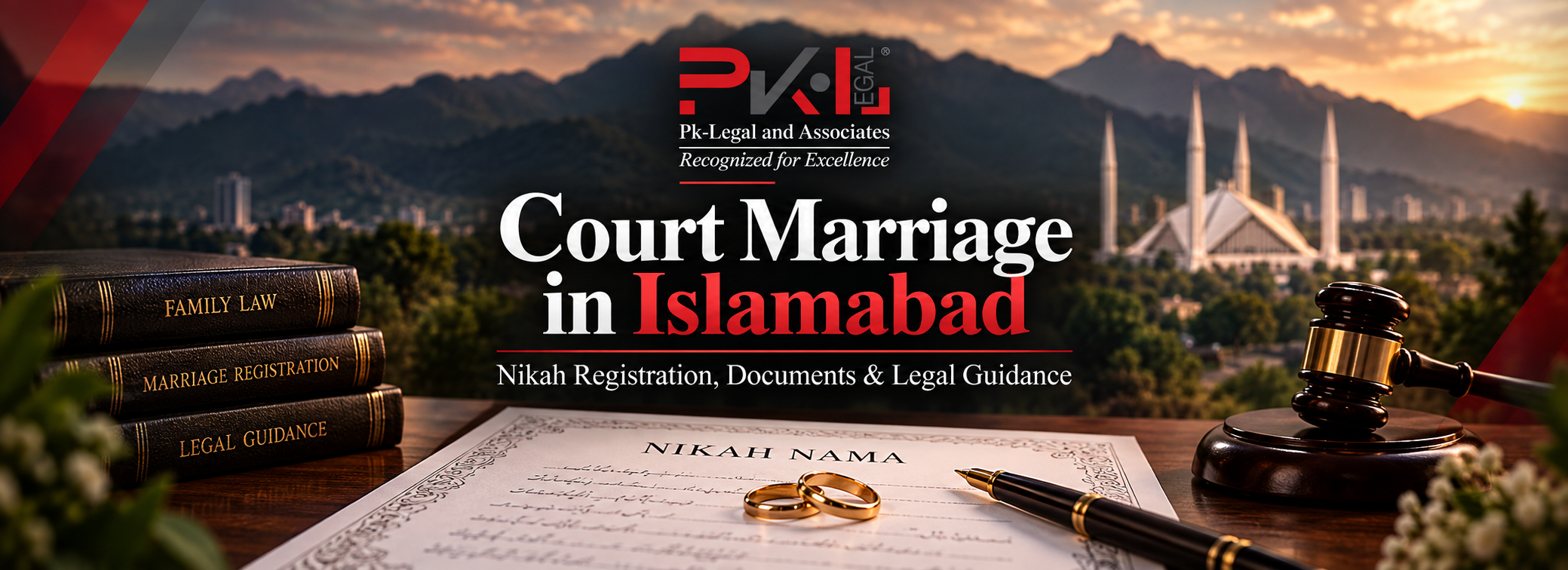
Court Marriage in Islamabad: New Age Rules, Documents and Nikah Registration
Couples preparing for a court marriage in Islamabad tend to arrive with the same questions: do we actually go to court, what documents do we need, are witnesses required, and how does registration work? This year added a new one — the minimum legal age to marry in Islamabad changed in 2025, and it’s caught a lot of people, and a lot of older website content, off guard.
Section 5, MFLO 1961
Nikah Nama vs. MRC
The New Minimum Age Requirement in Islamabad
This is the single most important update for anyone marrying in the federal capital this year. The Islamabad Capital Territory Child Marriage Restraint Act, 2025 was signed into law in May 2025, replacing the older Child Marriage Restraint Act, 1929 for Islamabad specifically. Under the new Act, anyone under 18 — male or female — is legally a child for marriage purposes, and a Nikah Registrar is barred from registering a marriage where either party is under that age.
For marriages taking place in Islamabad, the Nikah Registrar or person solemnizing the Nikah must ensure that both contracting parties possess valid NADRA-issued CNICs showing their respective dates of birth. This is a mandatory compliance step under the Act, not a discretionary best practice — a Nikah Registrar who registers an underage marriage, or fails to verify age through valid CNICs, can face criminal penalties, including imprisonment and a fine.
Can Adults Marry Without Their Parents’ Consent in Islamabad?
This question comes up often enough to deserve its own answer. For a legally competent adult Muslim woman, Pakistani case law has held that the consent of her wali (guardian) is not required for the validity of a marriage she contracts of her own free will.
That said, the parties still need to satisfy every other applicable legal requirement — age, identity, free consent, proper solemnization and registration. And where there’s serious family opposition, threats, allegations of abduction, or a genuine safety concern for either party, the situation should be assessed individually, with legal advice, before the marriage takes place rather than after a dispute has already started.
Is “Court Marriage” Actually Performed in Court?
Almost never, and this is one of the most persistent misconceptions around the term. A standard Muslim court marriage in Pakistan does not require either party to appear before a Family Judge to have the marriage solemnized. What actually happens is a Nikah that is properly solemnized, documented and registered. Couples often engage a lawyer to assist with document preparation, legal declarations, Nikah Nama review and registration — particularly where the circumstances are unusual — but that assistance is a practical choice, not a statutory requirement of the Nikah itself.
Court proceedings become relevant in separate situations — a dispute over marital status, a protection matter, family opposition escalating into litigation — but that’s a distinct scenario from the ordinary marriage and registration process most couples go through.
Documents Usually Required for Court Marriage in Islamabad
For a straightforward Nikah between two Pakistani adults, commonly required information and documents include:
Court Marriage Process in Islamabad: Step by Step
1. Initial Document Review
Confirm age, CNICs, nationality and marital status before anything else is arranged.
2. Agree the Nikah Terms
Decide Haq Mehr and any special conditions before the Nikah Nama is prepared, not while it’s being filled in.
3. Prepare the Nikah Documents
Enter the parties’ and witnesses’ details accurately in the Nikah Nama.
4. Solemnization of Nikah
The Nikah takes place with the required parties and witnesses present, according to the applicable Muslim law.
5. Sign the Nikah Nama
The document should be read before signature, and no important column should be left blank or casually completed.
6. Marriage Registration
The marriage is registered through the competent Nikah Registrar and the applicable local registration mechanism.
7. Obtain Subsequent Documents, if Needed
An MRC, translation, notarization, or other documentation may be required afterward depending on your purpose.
Haq Mehr Is a Decision, Not a Formality
Couples often treat the Haq Mehr entry as a box to fill in quickly. It shouldn’t be treated that way. Before the Nikah Nama is completed, both parties should actually agree on the amount, and on whether it’s prompt, deferred, split between the two, or tied to specific property. How this is recorded can carry real financial consequences years later if a dispute arises — it’s worth a genuine conversation, not a rushed entry.
Read the Nikah Nama Before You Sign It
The Nikah Nama is the actual legal record of the marriage — it isn’t paperwork to get through quickly. Beyond the Haq Mehr entries, it also records special conditions, any delegated right of divorce, and whether the husband has an existing marriage. Particular care should be taken with entries relating to prompt or deferred dower, property given as dower, delegated divorce, and special conditions, because these entries can later become directly relevant in Family Court proceedings if a dispute arises. Blank or hastily completed columns are a common source of disputes later, and they’re avoidable simply by reading the document before signing it.
For a closer look at what these columns actually mean and why they matter particularly for women’s legal position, our earlier guide on Nikah Nama clauses and women’s rights in Pakistan goes through this in more depth.
Witnesses Are Part of the Process, Not an Afterthought
For the standard Sunni Muslim Nikah ordinarily encountered in court-marriage practice, witnesses form part of the Nikah requirements, and their particulars are recorded in the Nikah Nama. If either party follows a different school of Muslim personal law, the witness requirements should be confirmed in advance rather than assumed. Either way, it’s worth confirming witness arrangements with your Nikah Registrar or lawyer ahead of time rather than assuming suitable witnesses can be found on the day.
Solemnization and Registration Are Two Separate Steps
Section 5 of the Muslim Family Laws Ordinance, 1961 requires every marriage solemnized under Muslim law to be registered in accordance with the Ordinance, and it provides for licensed Nikah Registrars and the prescribed Nikah Nama and marriage records. Completing the Nikah is one step; making sure it’s actually registered is a separate one, and it’s worth confirming this has genuinely happened rather than assuming signed paperwork alone is sufficient. (For readers tracking recent changes to this framework, see our note on the amendments to Sections 5 and 7 of the MFLO, 1961.)
A Nikah Nama Is Not the Same as a Marriage Certificate
This distinction causes genuine confusion. The Nikah Nama is the marriage contract itself. A Marriage Registration Certificate is a separate, computerized record obtained once registration is complete — and depending on what you need proof of marriage for, particularly immigration or embassy purposes, you may need one, the other, or both, sometimes with translation or further attestation. If you need a certified copy of a Nikah Nama already registered in Islamabad or Rawalpindi district specifically, see our Nikah Nama duplicate copy retrieval service.
Does It Matter Where in Islamabad the Nikah Is Registered?
Registration should proceed through the competent Nikah Registrar or local authority actually having jurisdiction over the marriage — this isn’t simply a matter of choosing whichever registrar is most convenient. Couples should verify the appropriate registration jurisdiction for their specific circumstances before proceeding, since getting this wrong can create delays or complications with the registration later.
When One Party Is a Foreign National
Islamabad sees a steady stream of these cases — a foreign national marrying a Pakistani citizen, an overseas Pakistani, or a couple needing documents for immigration purposes. There’s no single checklist that safely applies to every situation; passport and visa status, proof of an unmarried or divorced status, and any conversion documentation all vary by nationality and circumstance. For a more detailed checklist, see our guide to marriage registration between a foreign national and a Pakistani citizen. These cases are worth reviewing before the foreign party travels, not after arrival.
When It’s Worth Involving a Lawyer
A lawyer’s role here isn’t running a ceremony — it’s making sure both parties understand exactly what they’re signing and that the documentation reflects what was actually agreed. This matters most where families are opposed, where either party was previously married, where a foreign national is involved, where meaningful Haq Mehr or property is at stake, or where immigration documents will be needed later. Sorting these questions out before the Nikah is considerably easier than untangling a badly drafted Nikah Nama after a dispute has already started.
PK-Legal & Associates assists with court marriage documentation in Islamabad, including preliminary document review, Nikah Nama preparation and review, Haq Mehr and special-condition guidance, witness arrangements where applicable, marriage registration assistance, MRC-related documentation, translation and notarization, and marriages involving foreign nationals.
Preparing for a Nikah in Islamabad?
If your situation involves document preparation, registration, a foreign national, a previous marriage, or anything you’re unsure about, our court marriage procedure, requirements and fee guide covers the complete process, current fee, and what to bring.
Related Reading
Court Marriage Procedure, Requirements & Fee
The complete process, eligibility, documents, and current professional fee.
Nikah Nama Clauses & Women’s Rights
What the Nikah Nama’s key columns actually mean, and why they matter.
Marriage Registration for a Foreign National
Documents and process where one party is not a Pakistani citizen.
Frequently Asked Questions
What is the minimum age to marry in Islamabad now?
18 for both parties, under the Islamabad Capital Territory Child Marriage Restraint Act, 2025, which replaced the older 1929 Act for Islamabad specifically. A Nikah Registrar in Islamabad is barred from registering a marriage where either party is under 18, and must verify age through valid NADRA-issued CNICs.
Does this 2025 age law apply outside Islamabad too?
No, not automatically. The 2025 Act is specific to the Islamabad Capital Territory. Other provinces and territories have their own applicable minimum age requirements, which can differ, so this should be checked separately for a marriage taking place elsewhere in Pakistan.
Do parents have to consent to a court marriage in Islamabad?
For a legally competent adult Muslim woman, Pakistani case law — notably Hafiz Abdul Waheed v. Mrs. Asma Jehangir, PLD 2004 SC 219 — has held that her wali’s consent is not required for the marriage to be valid, provided every other legal requirement is satisfied. Family opposition is a separate practical concern worth taking seriously, but it isn’t the same as a legal requirement for consent.
Do we need to appear before a judge for a court marriage?
Ordinarily, no. A standard Muslim court marriage is a documented Nikah completed and registered through the competent Nikah Registrar, not a proceeding before a Family Judge. Court involvement is a separate matter that only arises if a dispute or protection issue comes up later.
Which documents are required for court marriage in Islamabad?
For two Pakistani adults marrying for the first time, this generally includes original CNICs, the details needed for the Nikah Nama, agreed Haq Mehr terms, and witness details. Where either party was previously married, supporting divorce or death documentation is also typically needed. The exact checklist depends on nationality and circumstances.
What’s the difference between the Nikah Nama and the marriage certificate?
The Nikah Nama is the marriage contract itself, completed and signed at the time of the Nikah. The Marriage Registration Certificate is a separate computerized record issued once registration is completed. Depending on what you need to prove and to whom, you may need one or both.
Can the Nikah and registration be completed on the same day?
The Nikah and initial documentation can often be completed quickly in straightforward cases, but registration and issuance of the certificate can take additional time. Anyone working to an embassy or travel deadline should allow for this separately.
What is the court marriage fee in Islamabad?
The total cost depends on the documentation and services actually required. For current PK-Legal professional charges and the complete service package, see our Court Marriage Procedure, Requirements and Fee page.
Latest Posts
-
 Legal Services to Overseas PakistanisSeptember 20, 2026
 -
 PLD 2026 SC 91: Khula, Cruelty & Dower RightsSeptember 19, 2026
 -
-
 Court Marriage in Islamabad: New Age Rules, Documents and Nikah RegistrationSeptember 15, 2026
 -
 Can You Divorce by SMS or WhatsApp in Pakistan? The LawFebruary 23, 2026