

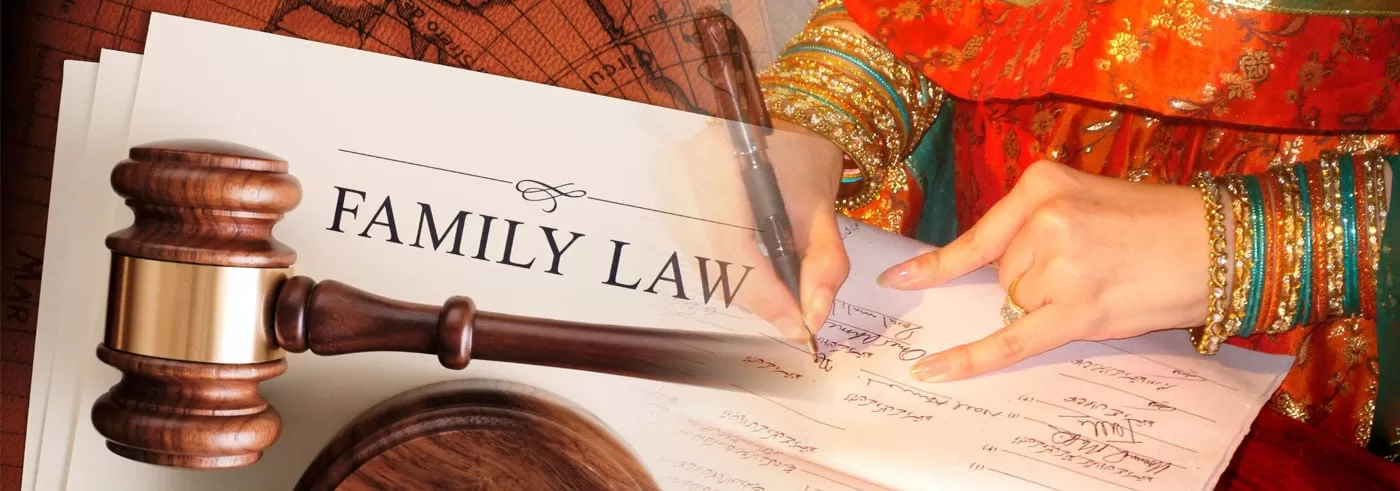
Nikah Nama in Pakistan: Every Important Column and Women’s Rights Explained
A Nikah Nama is Pakistan’s prescribed Muslim marriage contract and official record of the terms accepted at the time of Nikah. Its entries determine much more than the names of the spouses: they record Haq Mehr, whether any part was paid, property transferred against dower, special conditions, delegated divorce under Column 18, restrictions recorded under Column 19, any separate maintenance or dower agreement, and the bridegroom’s existing-marriage status. This guide explains the prescribed form column by column, identifies which rights exist automatically under law, and shows which protections must be expressly negotiated and written before signing.
Columns 13–20 Explained
Section 5, MFLO 1961
What Is a Nikah Nama?
The Nikah Nama is the prescribed documentary record of a Muslim marriage in Pakistan. It identifies the bride and bridegroom, their representatives and witnesses, records the date and place of Nikah, states the agreed dower, and documents contractual terms accepted by the spouses.
Section 5 of the Muslim Family Laws Ordinance, 1961 requires every Muslim marriage to be registered in accordance with the statutory framework. The Rules made under the Ordinance prescribe Form II as the form of Nikah Nama and regulate its preparation, signatures, copies and delivery to the Union Council.
Primary legal references include:
Nikah, Nikah Nama and Marriage Registration Certificate Are Different
Nikah
The marriage itself, formed through lawful offer and acceptance, free consent and the other applicable legal and religious requirements.
Nikah Nama — Form II
The prescribed contract and registration form containing the parties’ particulars, witnesses, dower and agreed conditions. Form II is the Nikah Nama; it should not be confused with the computerized certificate.
Marriage Registration Certificate
The computerized civil-registration document issued through the competent local authority after registration. It is commonly called a “NADRA marriage certificate,” although it is ordinarily obtained from the Union Council or designated local authority rather than directly from a NADRA Registration Centre.
Who Completes and Signs the Nikah Nama?
The licensed Nikah Registrar is responsible for completing the prescribed form where the marriage is solemnized by him. If another person solemnizes the marriage, the Rules require the prescribed form to be completed, signed and delivered with the registration fee to the competent Nikah Registrar.
Depending on the entries and how the Nikah is conducted, the form includes signatures or thumb impressions of:
The bride should be able to read the completed terms or have them accurately read and explained to her before signing. A signature should reflect informed and free consent to the recorded contract, not merely attendance at a ceremony.
Complete Guide to the 25 Columns of the Nikah Nama
The prescribed Form II contains 25 numbered entries. Some provincial versions may include added declarations or modified wording, but the traditional structure is as follows.
Columns 1–6: Place, Identity and Age
Column 1 records the ward, town or union, tehsil or police-station area and district where the marriage took place. Columns 2–3 record the bridegroom, his father, residence and age. Columns 4–6 record the bride, her father, their residences, her marital status and age.
Columns 7–10: Representatives and Their Witnesses
Column 7 identifies the bride’s representative, if appointed. Column 8 identifies witnesses to that appointment. Column 9 identifies the bridegroom’s representative, if appointed, and Column 10 identifies witnesses to his appointment. A representative should not be inserted merely as a formality where no valid appointment occurred.
Columns 11–12: Marriage Witnesses and Date
Column 11 records the witnesses to the marriage, including the required identification and residence particulars. Column 12 records the date on which the marriage was contracted.
Columns 13–16: Haq Mehr and Property Given Against Dower
Column 13 records the amount of dower. Column 14 states how much is prompt and how much is deferred. Column 15 records the portion paid at the time of marriage. Column 16 records property given in place of all or part of the dower, including its agreed valuation and relevant details.
Column 17: Special Conditions
Column 17 is the space for lawful special conditions agreed by the spouses. This may include clearly drafted terms concerning residence, education, employment, financial arrangements or other marital commitments. Conditions must be specific, lawful, possible to perform and consistent with public policy and applicable personal law.
Column 18: Delegated Right of Divorce
Column 18 asks whether the husband has delegated the power of divorce to the wife and, if so, subject to what conditions. This is known as Talaq-e-Tafweez. It is not the same as Khulla and should never be crossed out without the bride and bridegroom consciously deciding the issue.
Column 19: Restriction on the Husband’s Right of Divorce
Column 19 records whether the husband’s right of divorce is restricted in any manner. Any proposed limitation or financial consequence must be drafted carefully. Not every restriction or penalty written casually will necessarily be enforceable.
Column 20: Separate Dower or Maintenance Document
Column 20 records whether a separate document was prepared at the time of marriage concerning dower, maintenance or another related matter and provides a brief description. If such an agreement exists, it should be signed, dated, safely retained and identified sufficiently to connect it with the Nikah Nama.
Columns 21–22: Existing Wife and Arbitration Council Permission
Column 21 asks whether the bridegroom already has a wife and, if so, whether he obtained the Arbitration Council’s permission for another marriage under the Muslim Family Laws Ordinance. Column 22 records the number and date of the communication granting that permission.
Columns 23–25: Solemnizer, Registration and Fee
Column 23 identifies the person who solemnized the marriage. Column 24 records the date of registration. Column 25 records the registration fee paid.
Haq Mehr: How Columns 13–16 Should Be Completed
Haq Mehr or dower is the wife’s enforceable financial right arising from the marriage. It is not a payment to the bride’s parents, a ceremonial figure or the same thing as dowry. The amount and payment terms should be agreed before the Nikah and written in a form that can actually be understood and enforced.
Column 17: Special Conditions That May Protect the Wife
Column 17 can be used to record lawful terms negotiated by the spouses. It should not contain broad moral promises with no measurable obligation. Each condition should identify what is promised, who must perform it, when it must be performed and what lawful remedy is intended if it is breached.
Depending on the parties’ circumstances and legal advice, conditions may address:
These are examples of topics, not ready-made clauses. A condition that attempts to defeat a statutory duty, determine future child custody regardless of the child’s welfare, impose an unlawful penalty or restrain a legal right absolutely may be challenged or held unenforceable.
Column 18: Talaq-e-Tafweez or Delegated Divorce
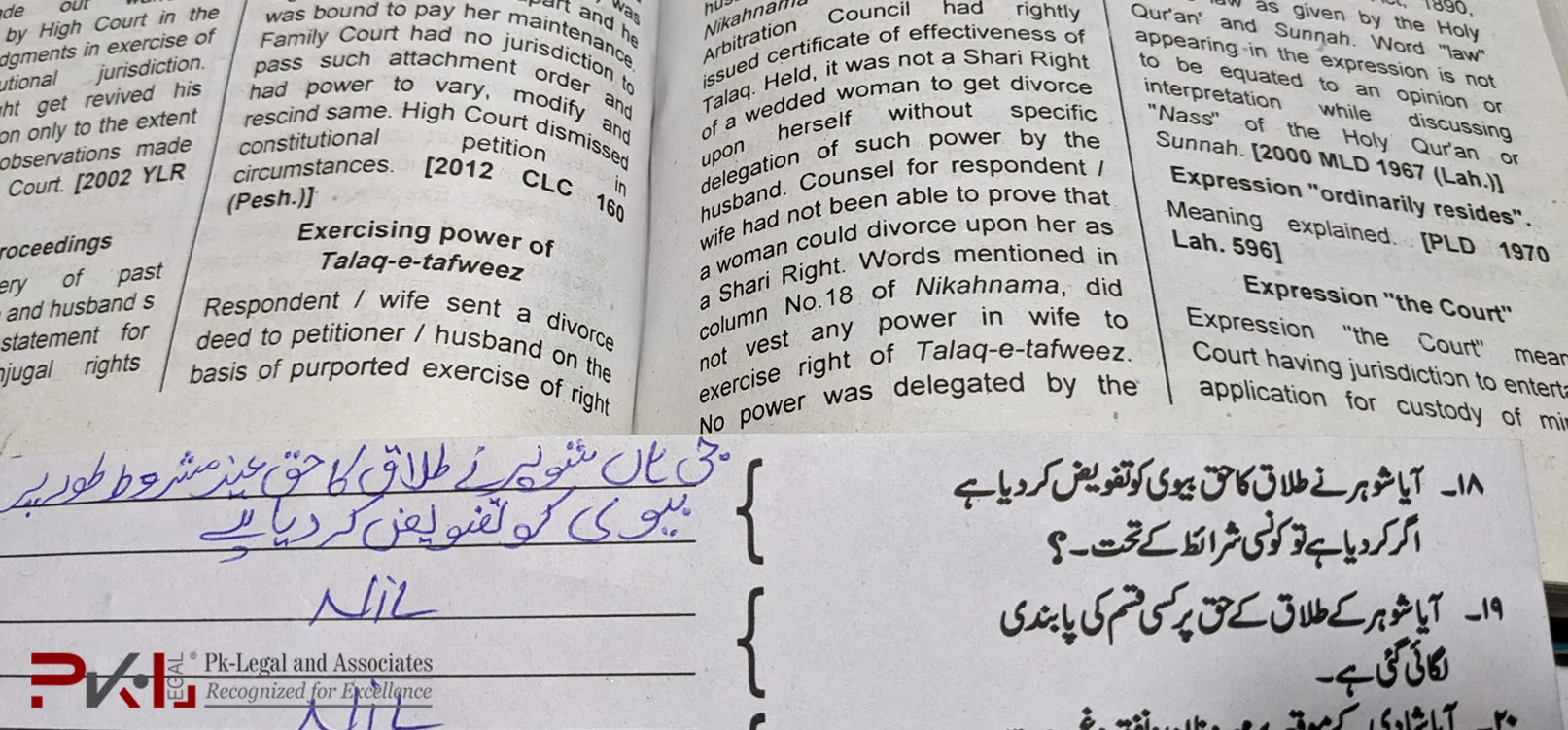
Column 18 allows the husband to delegate his power of divorce to the wife, either unconditionally or subject to recorded conditions. If validly delegated and exercised within its terms, the wife can proceed through the statutory delegated-divorce route without first obtaining a Khulla decree from the Family Court.
Talaq-e-Tafweez
Depends on an express delegation by the husband. The wife exercises the delegated authority under the terms written in the contract, followed by the applicable notice and Arbitration Council process under Section 8 read with Section 7 of the MFLO.
Khulla
Is an independent judicial remedy. If Column 18 is blank or crossed out, the wife does not lose her right to seek Khulla through the Family Court without the husband’s consent.
Read our dedicated guide to Column 18 and Talaq-e-Tafweez in Pakistan, or the complete Khulla procedure where no delegated right exists or the wife chooses the judicial route.
Columns 19–20: Restrictions and Separate Agreements
Column 19 is frequently misunderstood. It does not itself create a standard maintenance entitlement or contain a printed penalty. It asks whether the husband’s right of divorce is curtailed in any manner. Any restriction should be reviewed for clarity, legality and enforceability before it is written.
Column 20 is useful where the parties execute a separate document dealing with:
The separate document should not be left unidentified. State its date, title, number of pages and parties in Column 20, have all relevant persons sign it, and attach or preserve matching originals.
Columns 21–22 and a Husband’s Existing Marriage
Under Section 6 of the Muslim Family Laws Ordinance, a man must obtain the Arbitration Council’s previous permission in writing before contracting another marriage during the subsistence of an existing marriage. The application states the reasons for the proposed marriage and whether the consent of the existing wife or wives has been obtained.
Contracting another marriage without the required permission can produce financial and penal consequences, including immediate liability for the outstanding dower of the existing wife or wives under the applicable law. The consequence and penalty should be checked in the legislation currently in force in the relevant province or territory.
Women’s Rights That Do Not Depend on Being Written in Column 17
The Nikah Nama can strengthen proof and add negotiated protections, but it is not the source of every legal right. Several rights arise from law and the marriage itself.
Free and Informed Consent
A legally competent woman’s consent to marriage must be real and voluntary. A signature obtained through force, fraud or material misrepresentation can create serious legal consequences.
Haq Mehr
Dower is the wife’s right even though accurate entries are essential for proving the amount, payment status and terms.
Maintenance
A husband’s duty to maintain his wife does not arise only if a special condition is written. An express agreement can define or strengthen the arrangement but cannot be used casually to erase statutory remedies.
Separate Property
Marriage does not automatically transfer the wife’s property, earnings, gifts or inherited assets to her husband. Ownership depends on title, gift, transfer and applicable property law.
Khulla and Fault-Based Dissolution
A blank Column 18 does not prevent the wife from seeking Khulla or another lawful dissolution remedy through the Family Court.
Child Welfare
Custody and guardianship are determined according to the welfare of the minor. The parents cannot conclusively remove the court’s welfare jurisdiction through a pre-written Nikah Nama term.
For maintenance remedies, see our guide to wife and child maintenance in Pakistan. For the wider statutory framework, read the section-by-section Muslim Family Laws Ordinance guide.
What the Bride Should Check Before Signing
1. Verify Every Identity Entry
Match names, parentage, CNIC numbers, dates of birth and addresses against original identity documents. Spelling inconsistencies can later affect registration, immigration and enforcement.
2. Confirm the Bridegroom’s Marital Status
Do not leave Columns 21–22 unanswered. If he has an existing wife, inspect the Arbitration Council’s written permission and record its correct number and date.
3. Complete All Dower Entries
Check the total amount, prompt and deferred portions, payment made and any property transferred. Never sign a false acknowledgment that dower has been received.
4. Read Columns 17–20 Word for Word
Ensure agreed conditions, delegated divorce and related documents are expressed exactly as intended. Do not accept “we will fill it later.”
5. Strike Through Unused Blank Space Safely
After recording the answer, unused space should be closed in a manner that prevents later insertion. Any correction should be made transparently and authenticated by the required signatures rather than concealed with overwriting or correction fluid.
6. Obtain the Bride’s Signed Copy
The Rules contemplate a copy for the bride. She should keep it independently, scan it in color and avoid allowing all originals to remain with another family member.
Marriage Registration and Copies of the Nikah Nama
The traditional Rules require Form II to be prepared in multiple copies: the original remains in the register, copies are supplied to the bride and bridegroom, and another copy is forwarded for the Union Council record. Current local practice and the number or format of copies can vary because of amendments and computerized registration systems.
After registration, the competent local authority may issue the computerized Marriage Registration Certificate. Registration is important for:
Failure to register does not necessarily make an otherwise valid Muslim marriage void solely because registration was omitted, but it can create serious proof and record problems and may expose the responsible person to statutory penalties.
Where the bride’s copy is lost, a certified copy may ordinarily be requested from the official record held by the competent authority. PK‑Legal currently assists with retrieval of Nikah Nama and marriage records registered in Islamabad or Rawalpindi.
Can a Registered Nikah Nama Be Corrected?
Clerical errors in names, CNIC numbers, dates or addresses should be addressed promptly through the authority maintaining the record. The required application, supporting identity documents, affidavits and approvals depend on the nature of the mistake and the local procedure.
A substantive dispute is different from a typographical correction. An allegation that:
may require evidence, forensic examination, a declaration from the competent court or criminal proceedings depending on the facts. Never try to “fix” an official copy by manually changing it after registration.
How Nikah Nama Rights Are Enforced
The enforcement route depends on the right and relief claimed.
Nikah Nama for Overseas and Foreign-National Couples
Where one spouse is a foreign national or the documents will be used abroad, the parties should confirm spellings exactly as shown on passports, disclose prior marital status accurately and prepare any required foreign document, divorce record, death certificate, translation or conversion evidence before the Nikah.
For international couples, read our guide to marriage registration between a foreign national and a Pakistani. If the Nikah Nama must be submitted abroad, see our certified Nikah Nama translation service.
Common Nikah Nama Mistakes to Avoid
Signing Blank Columns
Creates an opportunity for later insertion and leaves important rights undecided.
Crossing Out Column 18 Automatically
Removes a potentially important negotiated protection without informed discussion.
Writing “Paid” Without Payment
Can seriously weaken a later dower claim and create a direct factual dispute.
Using Vague Property Descriptions
An unidentified plot, house or jewellery promise may be difficult to prove or transfer.
Confusing Consent With Section 6 Permission
An existing wife’s consent is not itself the Arbitration Council’s written permission.
Losing the Bride’s Copy
Leaves the wife dependent on others for evidence of dower, delegation and special conditions.
Frequently Asked Questions About Nikah Nama and Women’s Rights
Is the Nikah Nama legally binding in Pakistan?
Yes. It is the prescribed record of the Muslim marriage and its agreed contractual terms. A particular condition must still be lawful, clear and enforceable under the applicable law.
Which Nikah Nama column gives the wife a right of divorce?
Column 18 records whether the husband has delegated the power of divorce to the wife and any conditions attached to that delegation.
Can a wife obtain Khulla if Column 18 is blank?
Yes. Khulla is a separate judicial remedy through the Family Court and does not depend on a delegated right in the Nikah Nama.
What happens if the dower payment mode is not written?
Section 10 of the MFLO presumes the entire dower to be payable on demand where the Nikah Nama or marriage contract does not specify the payment mode.
Can the wife include education or employment conditions?
The spouses may record lawful special conditions in Column 17. The wording should be precise and reviewed for enforceability rather than copied from a generic template.
Can parents decide the conditions without the bride?
The marriage contract records the spouses’ agreement. The bride’s consent must be informed and voluntary; family members should not substitute their decision for hers.
Does the wife need to sign that her Haq Mehr was received?
Only an amount or property actually received should be acknowledged as paid. A false entry should not be signed for convenience or ceremony.
Is permission from the first wife required for another marriage?
Section 6 requires previous written permission from the Arbitration Council. The application states whether the existing wife or wives consent, but their consent and the Council’s permission are legally distinct.
Is Form II the computerized Marriage Registration Certificate?
No. Form II is the prescribed Nikah Nama. The computerized Marriage Registration Certificate is a separate civil-registration document issued through the competent local authority.
Can a Nikah Registrar cross out columns without asking?
Important contractual choices should be answered on the informed instructions of the parties. The bride and bridegroom should review the completed form before signing and should refuse to sign an unauthorized alteration.
Should the bride keep her own Nikah Nama?
Yes. She should receive the copy intended for her, verify that it matches the signed form, scan it and preserve it independently.
Need a Nikah Nama Reviewed or Drafted Properly?
PK‑Legal and Associates assists with pre-marriage review, Haq Mehr clauses, special conditions, Column 18, separate marriage agreements, court-marriage documentation, foreign-national marriages, certified copies and enforcement disputes. Share your city and proposed terms before the Nikah so they can be reviewed while changes are still practical.
Related Marriage and Family Law Guides
Muslim Family Laws Ordinance, 1961
Section-by-section explanation of marriage registration, polygamy, Talaq, maintenance, dower and succession.
Column 18 and Delegated Divorce
How Talaq-e-Tafweez is granted, conditioned and exercised under Sections 8 and 7 of the MFLO.
Court Marriage in Pakistan
Eligibility, free consent, witnesses, Nikah, Form II registration and the Marriage Registration Certificate.
Khulla Procedure in Pakistan
The Family Court remedy available to a wife without requiring the husband’s consent or a delegated right.
Wife and Child Maintenance
Legal duties, interim maintenance, evidence, calculation and enforcement through the Family Court.
Foreign-National Marriage Registration
Documents, identity checks, Nikah Nama registration and international-use requirements.
Latest Posts
-
 Legal Services to Overseas PakistanisSeptember 20, 2026
 -
 PLD 2026 SC 91: Khula, Cruelty & Dower RightsSeptember 19, 2026
 -

-
 Court Marriage in Islamabad: New Age Rules, Documents and Nikah RegistrationSeptember 15, 2026
 -
 Can You Divorce by SMS or WhatsApp in Pakistan? The LawFebruary 23, 2026