
Can You Divorce by SMS or WhatsApp in Pakistan? The Law
Sent or received a divorce message and not sure what it actually means? Pakistani courts have ruled on this directly — the answer is more specific than yes or no, and the process doesn't end with the text. A text message saying "I divorce you" is legally admissible evidence in Pakistan — but admissible isn't the same as complete. Here's what the courts have actually ruled, and what still has to happen after the message is sent.
Muslim Family Laws Ordinance, 1961: A Comprehensive Guide
This guide explains the Muslim Family Laws Ordinance, 1961 section by section, covering marriage registration, polygamy, Talaq, delegated divorce, maintenance, dower and succession, together with their practical application under Pakistan’s family-law framework.

What is dissolution of marriage by the court in Pakistan?
In this article, "What is dissolution of marriage by the court in Pakistan?" we are going to write an answer to a few very common questions asked by many Pakistani females. Khulla, by definition, is a form of divorce according to which a husband denies divorcing his wife and the wife seeks divorce through a prescribed law. If the wife wants to obtain a divorce, then she will have to file a suit for Dissolution of Marriage in the Family court of her area and the Family Court will issue a decree of divorce after hearing the case. Khula is a right given to the female in Islam as well as under Pakistani Laws.

Step by Step Divorce Process at Union Council in Pakistan
Know about Different Steps of a Divorce Process at the Union Council in Pakistan
A divorce not routed through the procedure contemplated by Section 7 of The Muslim Family Laws Ordinance 1961, does not become effective. Both parties can nominate their representatives/lawyers to pursue Arbitration/Union Council Proceedings however one-time in-person presence is a must. If we divide the complete divorce process into phases then we can split it into two major phases...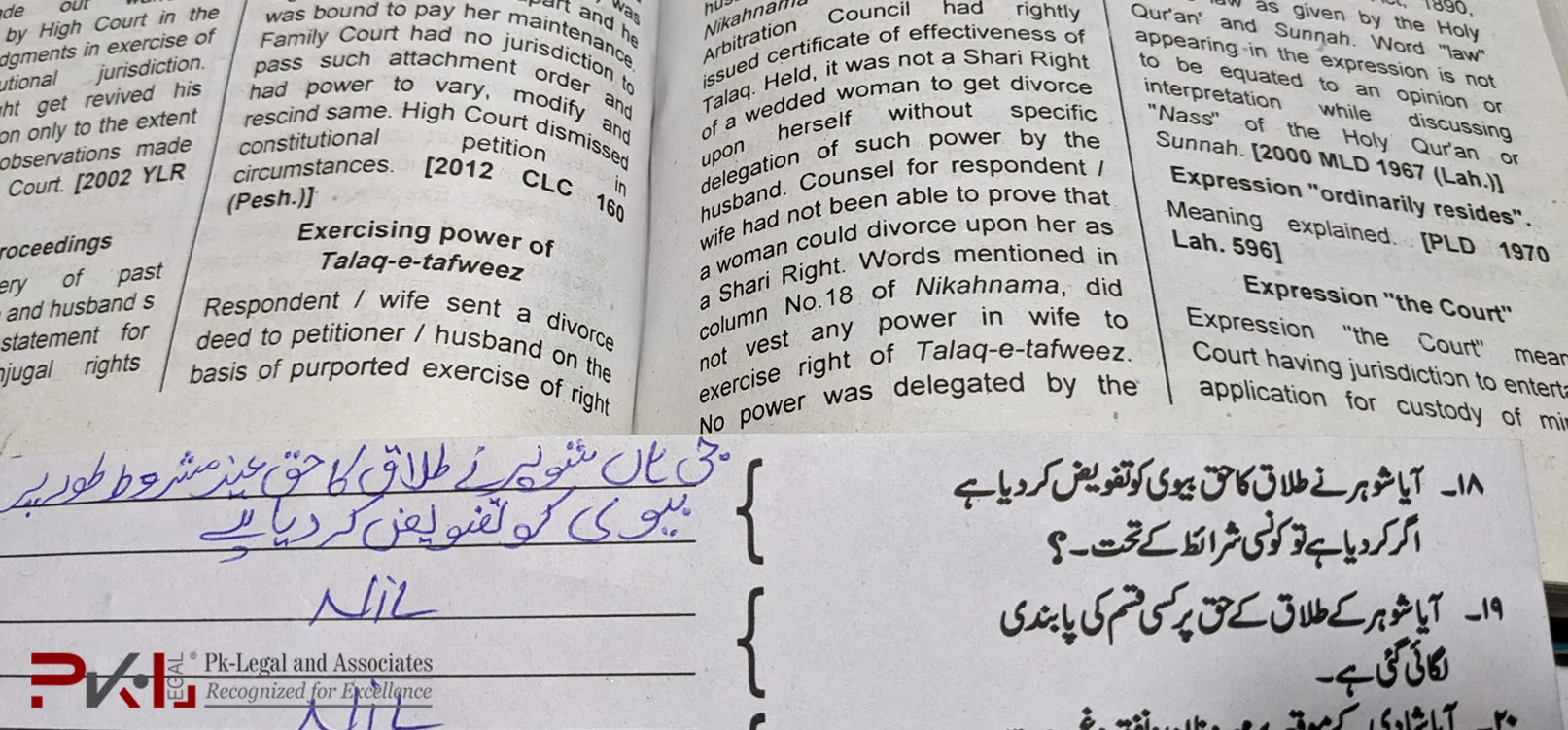
What is Women’s right to divorce in Pakistan? Column 18 of Nikahnama, a rarely used provision in Pakistan
Explanation of Women’s right to divorce / Talaq-e-Tafweez (Column 18 of Nikahnama) in Pakistan
What is Column 18 of Nikahnama in Pakistan? Column 18 of the Nikahnama in Pakistan, under the Muslim Family Laws Ordinance 1961, is a significant section that relates to the bride's right to delegate the power of divorce to herself. This provision is known as the "Delegation of the Power of Divorce" or "Talaq-e-Tafweez".Latest Posts
-
 Legal Services to Overseas PakistanisSep 20, 2026
 -
 PLD 2026 SC 91: Khula, Cruelty & Dower RightsSep 19, 2026
 -
-

-